Standard Ebooks
standardebooks.orgOctober ended the wonder streak with the sensible pick. For November we went looking for something underrated and came back with a library. Standard Ebooks is a volunteer project that takes public-domain classics, typesets them to a published style manual, proofreads them against scans of the original pages, and gives them away. More than 1,540 books so far. Every one is free, every one is dedicated to the public domain, and every one is its own GitHub repository. The website that hands them out is 14.7 KB of hand-written XHTML with no JavaScript, no analytics, no cookie banner and no account. The people who know about it won’t stop talking about it. Almost nobody knows about it. We’re fixing that.
Free, Public Domain, and Yours to Fork
Free is the easy part. Standard Ebooks also gives up ownership. The texts and the cover paintings are already in the U.S. public domain, and the project dedicates everything it adds, the markup, the typesetting, the cover design, the metadata, the blurbs, to the public domain as well, under CC0. The toolset that builds the books is GPLv3 on GitHub. The website’s own source code is on GitHub too, also CC0. Each ebook lives in its own Git repository, 1,545 of them under the standardebooks organization, so a typo fix is a pull request and the complete edit history of Ulysses is one click from its download page. One caveat, printed on every book page: public domain in the United States is not public domain everywhere, so readers elsewhere are told to check their own law first.
Getting the books (and the tools)
Four ways in, from least work to most.
-
Just download one
Open any book page, pick a file, done. No account, no email, no DRM. Each title comes in four flavours: a compatible
epubfor nearly every reader and app,azw3for Kindle,kepubfor Kobo so you get Kobo’s good renderer instead of its bad one, and an “advanced epub” the site tells you plainly is for developers. Kindle owners get a separate cover thumbnail to copy over by hand because of a Kindle bug the help page describes at length, and the official advice on it is two words long: complain to Amazon. You can’t Send-to-Kindle the azw3 either. It’s a USB cable or the Kindle’s own browser. - Read it in the browser Every book page has a Read Online section: start from the table of contents, or load the whole book as one page. No app, no sign-in, no reading-progress nag. Prefer dark? The site follows your system setting, and the Settings page overrides it with a three-option form. No JavaScript is involved at any point.
- Feed it to your reading app The catalog is available as an OPDS feed your reader app can browse directly, plus Atom and RSS feeds of new releases and bulk downloads of whole collections. These are the one thing behind a door: they are for Patrons Circle members, $15 a month or $150 a year, which also puts your name on the masthead and gets you a vote on which wanted book gets produced next. Bandwidth costs money and this is how they pay for it.
-
Build your own
pipx install standardebooksgives you thesecommand. The README currently asks for Python 3.14, Java for the optional accessibility checker, and a terminal you’re comfortable in.se create-draftlays out a new book,se typogrifyfixes the quotes and dashes,se lintchecks the result against the Manual of Style, andse buildproduces the files. Want the whole website?git clone https://github.com/standardebooks/weband bring PHP 8.5.4 or newer, Apache, MariaDB and Manticore for search. The README has the full install script for Ubuntu 26.04.
The Backstory You Need
Around 2013, Alex Cabal was living in a small town in Germany where English-language books were hard to come by. He makes his living running Scribophile, a large online writing workshop, and describes himself as part of the life-support industry for writers. He downloaded classics from Project Gutenberg for an E Ink reader and couldn’t stand how they looked: straight quotes, hyphens doing the work of dashes, transcriptions old enough to predate Unicode. So he fixed them by hand, then wrote tools to fix them faster. The first thing released under the Standard Ebooks name was a pay-what-you-want Alice’s Adventures in Wonderland with illustrations by a friend. It made about a hundred dollars.
The GitHub organization dates from December 2014, the toolset from March 2015, and the website went live the same year. The method hasn’t changed since. One volunteer takes a book from start to finish, an editor oversees the work, a second person reviews it, and the text is checked against page scans from the Internet Archive, Google Books or HathiTrust. Spelling is modernized. Punctuation is mostly left the way the author and the printer set it. The project is organized as an L3C, a low-profit limited liability company, and donations are its only income. By the site’s own estimate a basic ebook costs close to a thousand dollars to produce; if you want a particular title made, sponsoring it is $900 plus two cents a word past the first hundred thousand.
The thousandth book, in May 2024, was Ulysses, built from the 1922 Shakespeare and Company first edition with corrections from the pre-1929 errata lists. Today the catalog passes 1,540. Six editors run the day to day, 368 patrons are listed on the masthead, the newsletter reaches more than 18,200 readers, the blog publishes real essays about the books, and the operation has never shown an ad. Three corporate sponsors get a logo in the footer and a line in the newsletter. That is the entire commercial surface of the thing.
Why The Site Wins
Standard Ebooks is underrated in exactly the way this feature exists to fix. It has no marketing budget, a founder who works on it nights and weekends, and a name that sounds like a committee. Then you open it. It scores on all four of our big categories, and the fifth, Innovation Factor, it earns the hard way: AVIF covers and a strict Content Security Policy on a site with no JavaScript at all. The teardown:
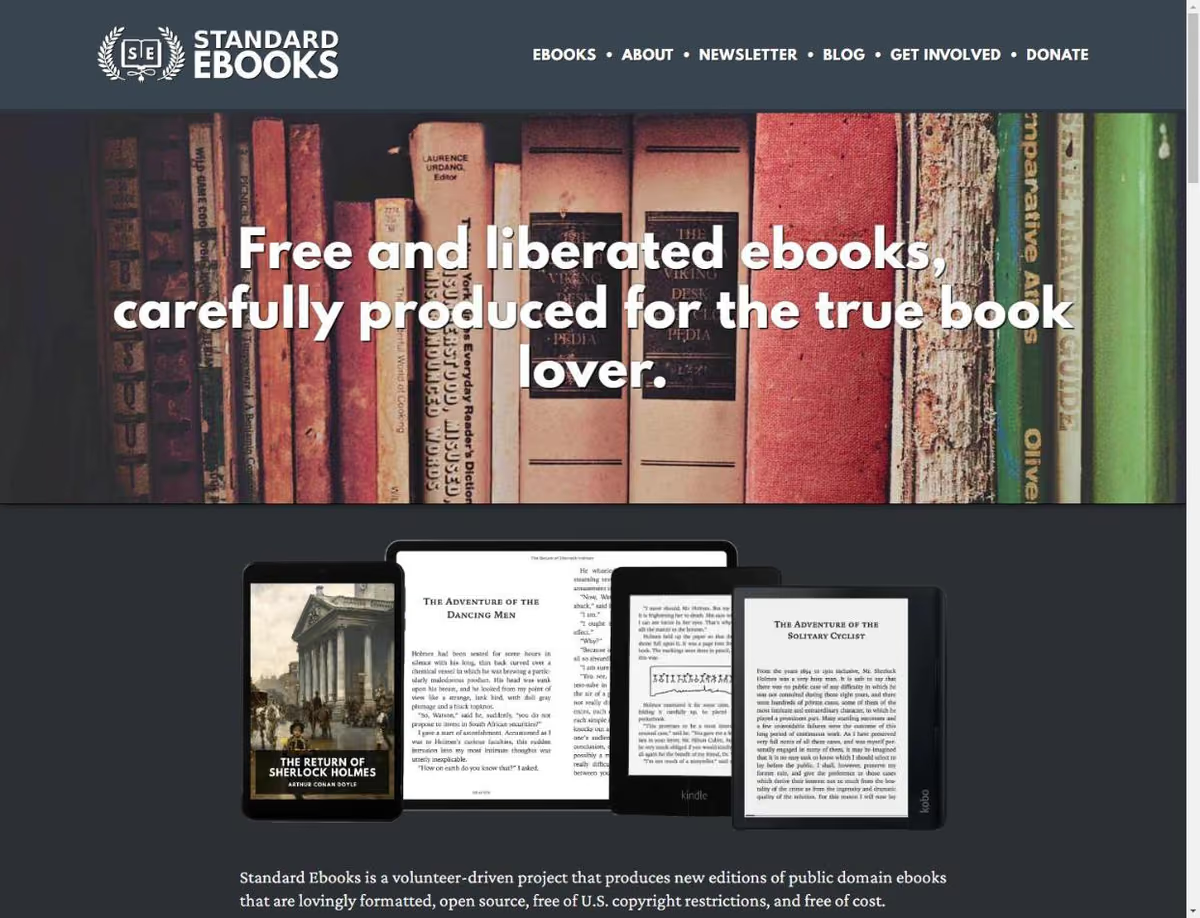
- Typography is the product, and the site practises it The project exists because free ebooks had straight quotes and hyphens where dashes belonged. The Manual of Style that fixes this runs to ten chapters, from XHTML code style to a full typography section, carries a version number like software, defers to the Chicago Manual of Style for anything it doesn’t cover, quotes Emerson on foolish consistency, and is released CC0 so you can adopt it wholesale. The website follows its own rules. Crimson Pro for text and League Spartan for headings, self-hosted as WOFF2 files, about 100 KB for the four that load first. Curly quotes in every sentence. A hero that shows you a page of Sherlock Holmes on four devices before it says a word about technology, and under it a before-and-after of bad and good typesetting for anyone who needs the argument made with pictures.
-
Zero JavaScript. Not minimal. Zero.
View source. There is no script tag on the homepage, none on a book page, none on the catalog with its subject filter, keyword search, sort order and per-page controls. All of it is HTML forms and a PHP server. The pages are served as
application/xhtml+xml, which means one unclosed tag and the browser shows an error instead of the page, a bet almost nobody makes in 2026. The Content Security Policy allows nothing from any other domain. Our first load: 23 requests, all from standardebooks.org, 14.7 KB of HTML, no cookies set. Dark mode is a 3 KB stylesheet behind a media query. The site has a Settings page, and it is one form with three radio buttons. - The book page shows its work Open Ulysses. 264,258 words, 16 hours 1 minute, a reading-ease score, its position on five best-of lists, an original description that runs through the obscenity trial and the misprints of the first edition, links to the Wikisource transcription and the Internet Archive page scans it was checked against, and the change history: on October 12 a volunteer changed “lace” to “large”, citing line 23,519 of the Gutenberg text and page 502 of the 1922 edition. Every book has this. A blog comparison this May found a $2 Amazon edition of a classic claiming to be a Penguin Classic. Here the provenance is the product page.
- Consistency as a design system Every cover uses the same layout: a public-domain painting, the title in League Spartan, the author beneath, the same frame. On the browse page 1,540 of them sit in a grid like one publisher’s backlist, which is what they are. The thumbnails are lazy-loaded AVIF with a JPEG fallback at 224 by 335, so the grid stays light. One reviewer this year called the covers “tasteful, albeit uninspired.” We’d call that the job description.
- The exits are on the front door The footer lists GitHub, Bulk Downloads, Ebook Feeds, Accessibility and Settings. Each book page links its own repository and explains how to report a typo. The accessibility page claims WCAG 2.2 AA for the ebooks and for the site, names the one page that falls short (the newsletter form) and offers an email address in its place. The public-domain page says in plain language what the project thinks of ninety-five-year copyright terms. No DRM, ever, in writing.
-
View source: the small jokes
The first link in the markup is hidden and reads “Following this link will ban your IP for 24 hours.” It is a honeypot for scrapers and a tidy demonstration of the
hiddenattribute. Pages for 1931 books already exist, with a countdown: Mourning Becomes Electra “will enter the U.S. public domain in 2 months on January 1, 2027.” They typeset next year’s books and sit on them until the law says go. The website’s README asks for PHP 8.5.4 or newer, which, eleven days after our own move to 8.5, we felt personally. - What we’d fix The number is hidden. “Over 1,540 ebooks” appears on the donate page and nowhere on the homepage, so a first-time visitor assumes a project a tenth the size. Put it in the hero. The hero itself is a bookshelf stock photo under a white headline, the one generic moment on an otherwise handmade site. The OPDS feed and bulk downloads are patrons-only, defensible on bandwidth and still a sting on a project whose pitch is “libre.” Illustrations are the known weak spot: that same May comparison preferred Gutenberg’s copy of one novel because Standard Ebooks had dropped the floor plans. And every download sits beneath a legal paragraph for non-U.S. readers. True, necessary, and still the first thing you read.
How It Actually Works
A visitor’s guide for the designer with ten minutes to spare:
In our whole visit we met no popup, no cookie banner, no chat bubble, no email gate and no login wall. The book you came for is two clicks away, and once you have it, it’s yours.
Why Designers Should Care
Because this is a working demonstration that the stack is optional. A catalog of 1,540 items with search, filters, sorting, pagination, dark mode and user settings, built from HTML forms, CSS and a server. No bundle, no framework, no hydration, no consent banner because there is nothing to consent to. Before the next project, ask which of those the client actually needs. Standard Ebooks’ answer was none of them, and the site loads faster than anything you’ll ship with all of them.
Because typography is the part of the job nobody thanks you for and every reader feels. This whole project exists over the difference between a straight quote and a curly one, which most people can’t name and everyone registers. You’ll notice this review uses curly quotes and not a single em dash in the body copy. We have a house rule about dashes. They have a chapter.
And because of October, extended. Ghost showed you software you can leave with. Standard Ebooks shows you content you can leave with: no account, no DRM, no license to read, the file is yours and the source is public. On January 1, everything published in 1931 enters the U.S. public domain, The Waves and The Good Earth among them, and somebody here already has the page scans open. Where your clients’ writing lives matters. So does whether anyone can still read it in eighty years.
The Best Site Nobody Told You About
Standard Ebooks is eleven years of volunteers, a style manual, a GitHub organization with 1,545 repositories and a website that proves none of the heavy machinery was ever required. More than 1,540 books, free, public domain, typeset better than the editions people pay for, on a site with no JavaScript, no trackers and no ads. It scores on Visual Design, User Experience, Technical Excellence and Business Impact, with the last one measured in books instead of money.
July gave you the world’s radio. August gave you strangers’ windows. September gave you the ruins of GeoCities. October gave you the sensible CMS. November gives you something to read on it: the quiet one, the underrated one, the site that would rather fix a comma in Ulysses than tell you it exists.
Go download a book. Then view source and have a quiet word with your bundle size. We did.