Radio Garden
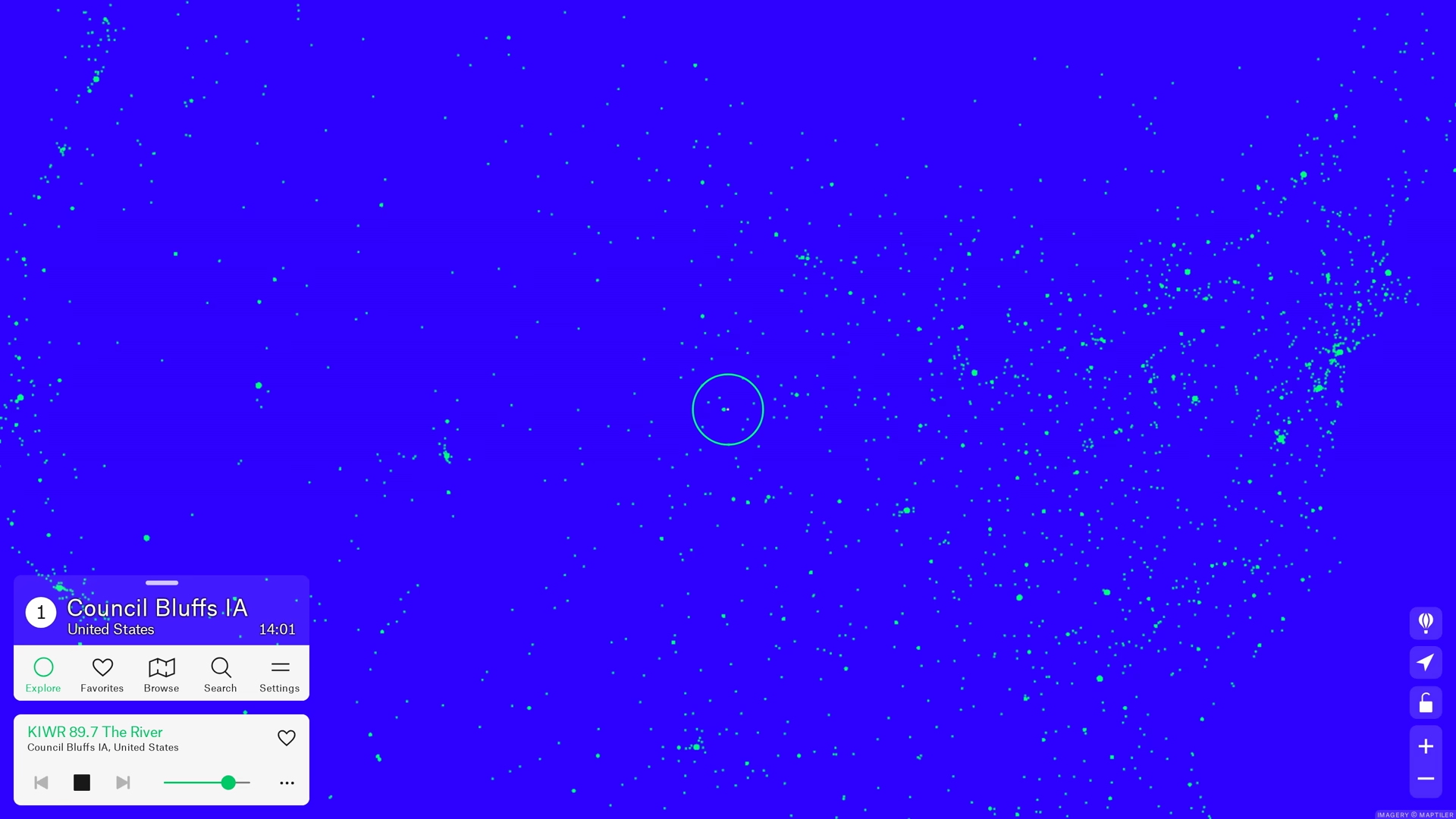
radio.gardenHere is the entire user manual: spin the globe, click a green dot. A second later you're inside drive-time in Lagos, a jazz hour in Osaka, or the morning show in Tórshavn, live, as it happens, free. For four months this feature has celebrated honest workhorses that refused to sell out. Radio Garden was never selling anything. It exists to remind you the web can still produce wonder, and it delivers that reminder in one click.
🌍 The Backstory You Need
Radio Garden started as a research exhibit, not a startup. Between 2013 and 2016, the Netherlands Institute for Sound and Vision — the Dutch national audiovisual archive — worked with the Transnational Radio Knowledge Platform and five European universities on a question: how does radio cross borders? To make the answer tangible, they brought in Studio Puckey and Studio Moniker, who delivered something no committee would ever have specced. All of the world's live radio, hung on a spinning planet.
It launched in December 2016 with roughly 8,000 stations and went viral almost immediately. It's that species of link people send each other with no caption, because the click explains itself. A ground-up rebuild shipped on March 14, 2020, giving the project its perfect home on the .garden domain, and the collection has since grown past 40,000 live stations. There are quieter corners too: History for archival radio moments, Stories for listeners telling you what radio means to them, Jingles for station sound-branding nerds. Worth a wander once the globe has you hooked.
And this is no nostalgia pick. Nearly a decade in, Radio Garden is still non-profit, still free, and still collecting fresh site-of-the-day nods from design blogs in 2026. The wonder held up. That almost never happens.
🎨 Why The Site Wins
Let's be honest about the streak. OpenShot, Proton, MajorGeeks, Serious Eats: four straight winners telling versions of the same story, the honest workhorse that refused to bloat, track, or sell out. Radio Garden breaks the pattern, and that's exactly why it's here. It isn't resisting the modern web's bad habits. It simply never picked them up. This is the first winner in the history of this feature that's a pure interactive experience — our Innovation Factor criterion with everything else stripped away. Restraint is admirable. Wonder is rarer. The teardown:
- The interaction is the product, not decoration on top of one Most "interactive" sites are a directory in a costume; strip the animation away and the list underneath still works fine. Strip the globe out of Radio Garden and nothing is left. Navigation, discovery, browsing, the whole information architecture: one gesture, pointed at a planet. It never reads as a gimmick, because there is no "real" interface hiding behind it.
- Zero onboarding, because none is needed No tutorial overlay, no tooltip tour, no "let us show you around!" modal. A turning globe covered in green dots explains itself in about a second, to a designer in Berlin or a kid in Manila, in any language. That's the actual meaning of intuitive: self-evident, no simplification required.
- No algorithm sits between you and the planet Nothing here is trending, promoted, or picked for you. Geography is the browse structure. A tiny community station in the Azores gets the same treatment as a national broadcaster: a dot on the planet, nothing more. Your listening history trains nothing. What you hear next is decided by where you point, and nobody is monetizing the pointing.
- No business model means no dark patterns There was never a growth team, so nothing is growth-hacked. Nothing asks for your email. Nothing gates minute eleven behind a signup. No premium tier squats on the good stations. A non-profit research project has no funnel to push you down, and you can feel that absence in every click.
- Engineering so good it vanishes Tens of thousands of live streams, from every timezone on Earth, and the gap between click and audio is about a second. No buffering spinner, no "connecting..." theater. The hardest technical problem on the site is the one you never notice, which is exactly where that effort belongs.
- Nearly a decade without cashing in The 2016 viral moment came and went. The 2020 rebuild could have arrived with a subscription bolted on; it arrived with a better globe instead. Years of chances to ruin it, all declined. Staying wonderful is a harder trick than becoming wonderful, and it's the part worth studying.
📻 How It Actually Works
The complete flow, with nothing edited out for brevity:
Notice what's missing: every step where a normal product would grab your elbow. No step asks who you are. No step tries to keep you. In 2026, a site that wants nothing from you reads as almost radical — and that absence is the design.
💡 Why Designers Should Care
Because this is one idea, executed completely, with everything else told no. No feed bolted on for retention. No personalization layer to justify a data team. No onboarding flow, because the design is confident enough not to need one. Radio Garden is what it looks like when a team finds the single interaction that matters and has the nerve to make it the entire product.
Steal accordingly. Steal the confidence: an interaction can be the product, rather than a flourish sprinkled over a grid of cards. Steal the restraint: it never explains itself, never gamifies itself, never mistakes friction for engagement. And steal the polish standard: delight only lands because the engineering underneath is invisible. A magical globe that buffered would just be a slow map.
Most design work is making useful things less annoying, and the last four winners prove how noble that is. But delight is also a deliverable. "Wonderful" is a spec you're allowed to write. The next time a brief has an inch of slack in it, remember the green dots.
Proof the Web Can Still Feel Like Magic
Radio Garden is a globe, 40,000 live radio stations, and one click. Archivists and designers built it to answer a research question; it escaped the lab in 2016 and spent the years since becoming the internet's favorite way to eavesdrop on the planet. It never charged admission, never demanded an email, and never ruined itself. In this feature's whole history there has been nothing like it: no product, no pitch, no funnel. Just the purest interaction design we've ever put on this page.
Four straight winners earned this spot through restraint, by refusing to become worse. Radio Garden wins it by refusing to be ordinary. Somewhere right now a bakery in Palermo has the radio on, a cab in Nairobi is arguing with a call-in show, a night DJ in Manila is talking to nobody in particular — and every one of them is a single green dot away from your desk.
Go spin the globe. The planet has been on the air this whole time.