Ghost
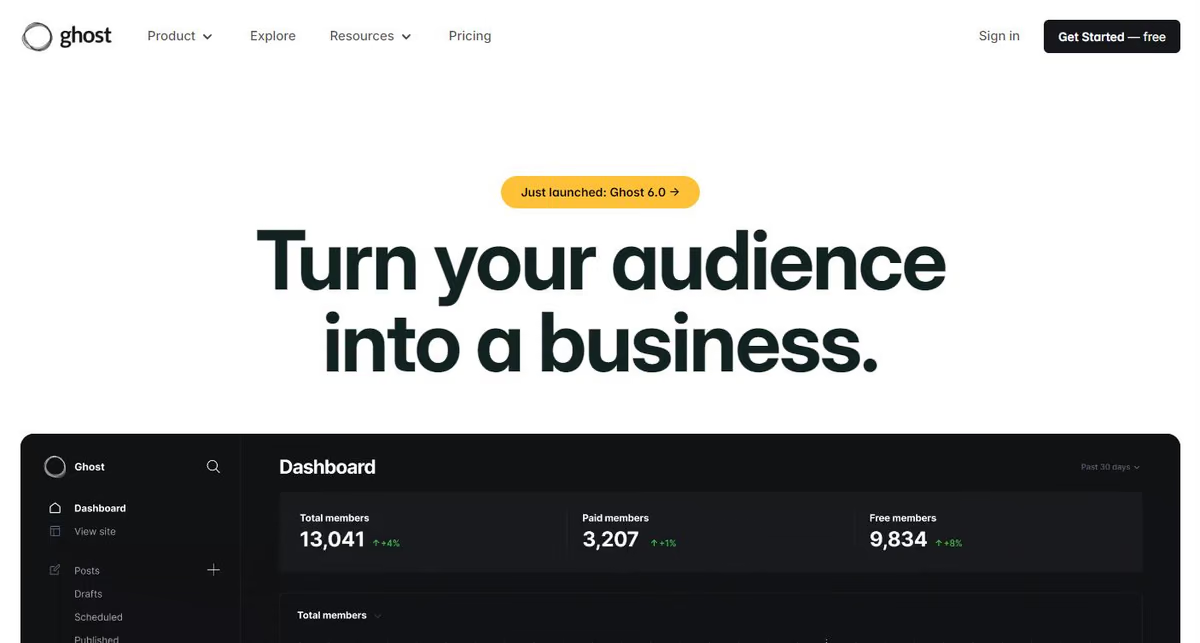
ghost.orgWe owe you a CMS review. We said so in August, said so again in September, then handed both months to something shinier. Here it is, and it won on merit. Ghost is open-source publishing software run by a non-profit foundation that legally can't be bought or sold, and ghost.org sells it the way the foundation operates. The headline is six words. The product sits directly under it, the real one, with no stock photo of a team high-fiving around a laptop. The About page streams the company's revenue live. Prices are on the pricing page, where prices go. Its first public release turns thirteen on October 14. In a month of costumes, the site called Ghost isn't wearing one.
👻 The Backstory You Need
In November 2012, John O'Nolan published a blog post with some mockups. He'd been deputy lead of WordPress's user interface team and had watched a blogging tool grow into a system for building anything at all. His pitch was a platform that did one job: publishing. The post travelled. In April 2013 he and developer Hannah Wolfe put the idea on Kickstarter asking for £25,000. They had it in 11 hours and finished 29 days later with £196,362.
The first public release shipped on October 14, 2013, and here's where the story leaves the usual script. The usual script goes: seed round, growth round, pivot, acquisition, sunset email. O'Nolan and Wolfe set Ghost up as a non-profit foundation instead. Its constitution means the company can't be bought or sold, and all revenue goes back into the product. The software is MIT-licensed and free to run on your own server. The money comes from Ghost(Pro), the paid hosting, for people who'd rather not babysit a server.
Thirteen years on, the model holds. The foundation runs at $11.1 million a year with a staff of 40 and has never had an office. Ghost 6.0 arrived in August 2025 with built-in analytics and a connection to the open social web, so a publication can be followed from Mastodon, Threads or Bluesky like any other account. By then its publishers had passed $100 million in combined earnings. The homepage's customer wall includes 404 Media, Platformer, Tangle and The Lever, which is a decent share of the independent journalism people actually pay for.
🎨 Why The Site Wins
Today is the day. In August we admitted the sensible move was a nice open-source CMS and gave the month to strangers' windows anyway. In September the review was two months overdue and we gave the month to GeoCities. Streak over. And this is no consolation prize. Radio Garden, WindowSwap and Cameron's World all won on Innovation Factor, which is 10% of our scorecard. Ghost wins on the other 90. It also happens to answer September's warning about building your home on somebody else's platform. The teardown:
- The About page is a bank statement Annual run rate, monthly revenue, net churn, paying customers. All of it sits on the About page, fed live, with a caption confirming the numbers are real. On the day we checked: $11,099,649 a year, 30,579 customers, 2.92% churn. Every SaaS site has a trust section made of grey logos. This one opened the books. You can't out-design that, and you can't fake it.
- Six words, then the product The homepage headline is six words long. Directly under it sits the actual admin dashboard, and further down the editor, the theme gallery and the member list play as short looping clips of the real interface. No isometric illustrations, no gradient blob standing in for the software. The top navigation has four items. You know what the thing looks like before you've scrolled, which most software sites avoid telling you for the entire page.
- The price is on the pricing page Drag a slider to your audience size and the plans reprice in front of you, starting at $15 a month on annual billing, then $29, then $199, all before anyone asks for an email address. Underneath is a full comparison table with no sales call until the Custom tier. On every plan that supports paid subscriptions, Ghost's cut is 0%. When prices went up alongside 6.0, the announcement said so plainly, explained why, and left existing customers on their old rates.
- The fine print is the pitch Most companies bury their ownership structure. Ghost prints it as marketing. One homepage section ends by declaring, in four words and one swear, that there are no investors. The About page explains that the foundation can't be sold and reinvests every dollar. For anyone choosing where to put ten years of writing, that's the feature. Nobody upstream is waiting on an exit, so nobody is going to redesign your dashboard around one.
- It shows you the exit The footer links to the install guide and the source code. The pricing announcement itself reminds you the software is free and you can host it wherever you like. A sales page that points at the free option is either reckless or very sure of itself. Thirty thousand paying customers suggest the second.
- View source: the right tool, even when it isn't theirs We looked. The marketing pages are a static build generated with Hugo. The changelog, where the team actually publishes, runs on Ghost. A CMS company that doesn't force its own CMS onto a brochure has understood what its product is for. Our first load made 143 requests and 138 came from ghost.org itself. No cookie banner greeted us, nothing loaded from Google, and 72 of the homepage's 73 images wait their turn.
- What we'd fix A yellow badge above the headline says Ghost 6.0 just launched. It launched in August 2025. The demo dashboard's chart ends in April 2022, and the integrations wall still flies the Twitter bird. A team this honest about its revenue can afford to be honest about the calendar.
🖱️ How It Actually Works
A visitor's guide for the designer with ten minutes to spare:
In our whole visit we met no chat bubble, no popup and no countdown timer. The site explains the product, shows the price and tells you who gets the money. Software, sold the way a hardware store sells a hammer.
💡 Why Designers Should Care
Because you build trust sections for a living, and this is the best one on the web. The standard kit is a row of client logos, five gold stars and a quote from somebody's Head of Growth. Ghost's kit is a revenue feed, a public codebase and a staff list with start dates. None of it took a designer to invent. It took a company willing to be looked at. Next time a client asks for social proof, ask what true thing they'd be willing to show instead.
Steal the layout logic too. The page assumes the product can sit directly under its own headline and survive the comparison. Most marketing sites exist to delay that moment. If a real screenshot would hurt the pitch, the problem was never the pitch.
And care because of September. Last month's winner was a monument to 38 million homepages that Yahoo deleted with one corporate decision. Ghost is what that lesson looks like as a product: software you can run yourself, a member list you can export, a company that can't be sold out from under you. Your clients' newsletters and membership sites will live somewhere. Part of the job is asking who holds the off switch.
Promise Kept
Ghost has spent thirteen years proving a software company can skip the investors, post its own revenue and still grow. The foundation runs at $11.1 million a year. Its publishers earn more than $100 million a year between them, by the homepage's count, and Ghost's cut is 0%. The website does the one thing a company like that needs it to do. It shows its work.
July gave you the world's radio. August gave you strangers' windows. September gave you the ruins of GeoCities. October gives you the sensible one: a tool for building something that won't end up in the next decade's ruins. The wonder streak ends at three. The CMS review is no longer overdue.
Yes, we gave October to a site called Ghost. Go read its About page anyway, then take a hard look at your own.