Proton
proton.meA Swiss privacy company built by CERN scientists, governed by a nonprofit foundation that legally cannot sell you out, running on hardware they own inside a granite bunker. Mail, VPN, Drive, Calendar, Pass, Docs, and a private AI — all end-to-end encrypted, all open source, all auditable. This is what the internet was supposed to look like before everyone gave up and let Google run it.
🇨🇭 The Backstory You Need
Proton started in 2014 when a group of scientists who met at CERN — the same place that invented the World Wide Web — decided to build an email service that couldn't read your mail. They crowdfunded it. Over 10,000 strangers chipped in roughly half a million dollars because the idea was that powerful: an inbox that the company hosting it physically cannot decrypt.
Eleven years later, they've grown to over 100 million users and a full suite of encrypted tools — Mail, VPN, Drive, Calendar, Pass, Docs, Sheets, Meet, Wallet, and Lumo (a private AI assistant they launched in mid-2025). They own their own hardware. They run their own network. Their backup data center is inside a former Swiss army bunker buried under 1,000 meters of granite. I'm not making that up.
And in June 2024, they did something almost no profitable tech company ever does: they handed control to a nonprofit. The Proton Foundation — board members include Tim Berners-Lee, the guy who literally invented the web — is now the primary shareholder. The legal structure means no one can buy Proton, no one can pivot it, no one can quietly start mining your data five years from now. It's locked in.
🎨 Why The Site Wins
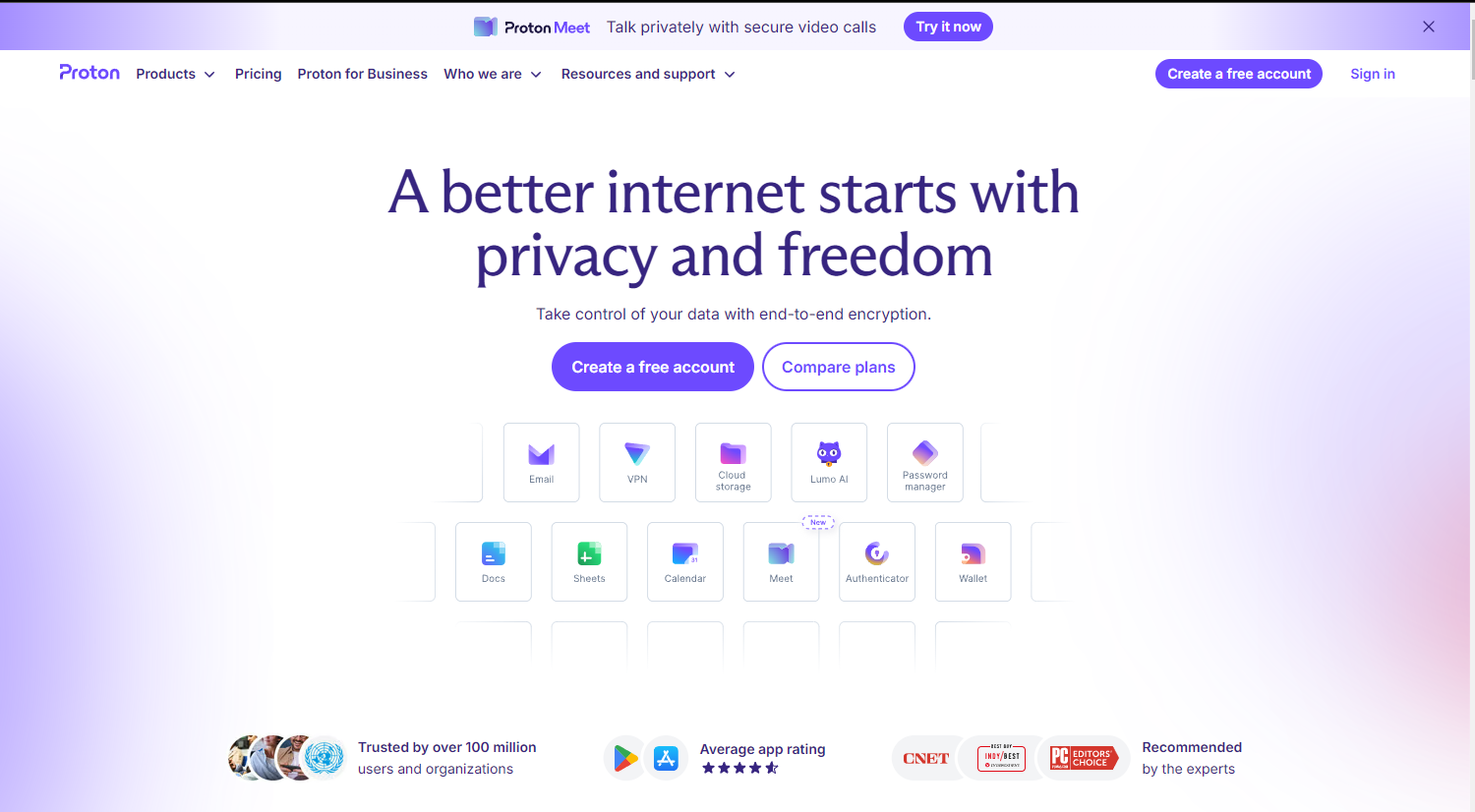
Beyond the mission, proton.me is just a genuinely well-built website. Here's what stands out when you take it apart:
- Confident dark mode that knows what it's doing Deep navy backgrounds with violet accents and gradient washes. None of that "we slapped a dark theme on at the last minute" garbage — every component was clearly designed dark-first, with text contrast that doesn't melt your retinas at 2am.
- Typography that actually has personality Big, bold headlines with confident weight transitions. They let whitespace breathe instead of cramming the screen with feature bullets. Reading the page feels like reading a manifesto, not a sales pitch.
- Product cards that don't insult your intelligence Each service gets a clean visual identity, an honest description, and a real screenshot. No fake dashboards. No stock photos of diverse teams pointing at laptops. Just the actual product.
- Trust signals that don't beg Swiss flag, "open source," "audited," "no logs." They're stated once, calmly, then they move on. Compare this to every VPN affiliate site screaming about encryption in 72pt red text.
- The mission is the marketing Most SaaS sites bury their "About" page. Proton puts the nonprofit story, the CERN origin, and the foundation governance front and center. Because for them, that is the differentiator. Every other "privacy" company eventually gets sold or pivots — Proton structurally cannot.
- Performance that respects your bandwidth The site loads fast, animations are subtle, and nothing autoplays. They're not chasing engagement metrics. Imagine that.
🛠️ The Suite
This isn't a single product — it's a full Google replacement, built end-to-end encrypted from day one. Every service below is included in a single Proton account:
💡 Why Designers Should Care
If you build websites for clients who value trust — lawyers, doctors, journalists, activists, anyone with sensitive data — Proton's site is a masterclass in how to communicate credibility without theatrics. They don't use trust badges. They don't flash "100% SECURE!!" banners. They calmly explain their architecture and let it do the talking.
The lesson: when your product is genuinely good, you can afford to be quiet about it. Restraint is a design choice. Most sites scream because they have nothing to say.
Also worth studying: how they handle a sprawling product line without making the homepage look like a feature dump. Every product has its own dedicated landing page with its own visual identity, but they all share a common design system. It scales without falling apart — something every agency struggles with the moment a client asks for "just one more thing."
Proton Is What Independence Looks Like
In an industry where every "privacy-focused" startup eventually gets bought, pivots to ads, or quietly starts logging metadata, Proton built a legal moat around their mission and refused to flinch. They sued Apple. They told the Swiss government they'd leave the country before adding a backdoor. They give 1% of revenue to digital rights organizations. They built their own AI rather than ship something that trains on user data.
Their website reflects all of that. It's calm, confident, well-designed, and entirely unapologetic. There's no growth-hack copy, no dark patterns, no countdown timers. Just a product that works and a company that means what it says.
That's a rare thing on the modern web. It deserves recognition.